


The Brief · Issue 11 · May 19, 2026 · 10 min read
Food Safety Summit 2026: Seven Sessions, One Blind Spot
Food Safety Summit 2026 wrapped May 14 in Rosemont. The content was strong, the speakers credible, the case studies real. Every playbook on stage assumed you were Cargill, Nestlé, or McDonald's. The smaller operator was missing from the conversation. Notes on what worked, what did not, and where the gap was loudest.
Food Safety Summit 2026 wrapped May 14 in Rosemont. Four days, dozens of sessions, mostly stocked with speakers from McDonald's, Cargill, Nestlé, OSI Group, Chick-fil-A. I sat in on seven that I want to write about. The content was strong. The blind spot was the same in every room. None of the playbooks on stage were built for a small to mid-size manufacturer. That gap is the story.
First Summit for me. Walked in fresh. The veterans of this conference may have stopped seeing the gap. I couldn't.
The AI workshop made the gap obvious
Cindy Jiang ran the opening AI workshop. It was the most informative session I sat in on all week.
The breakout discussion was more useful than the keynotes. The QA leads at my table were all using ChatGPT, Claude, or Gemini at work, with almost no prompting technique. A few had picked up the trick of having one model check another's output. Most hadn't. Citations, hallucinations, accuracy: every objection I heard is the same objection I heard from the same role two years ago.
Two things stuck.
Sean Leighton at Cargill said from the stage that the AI and software systems they're building have potentially prevented something like 42 food safety incidents. I don't know exactly how Cargill defines that and I doubt it's a public number. The directional point is right. AI applied against your own data finds things human review misses.
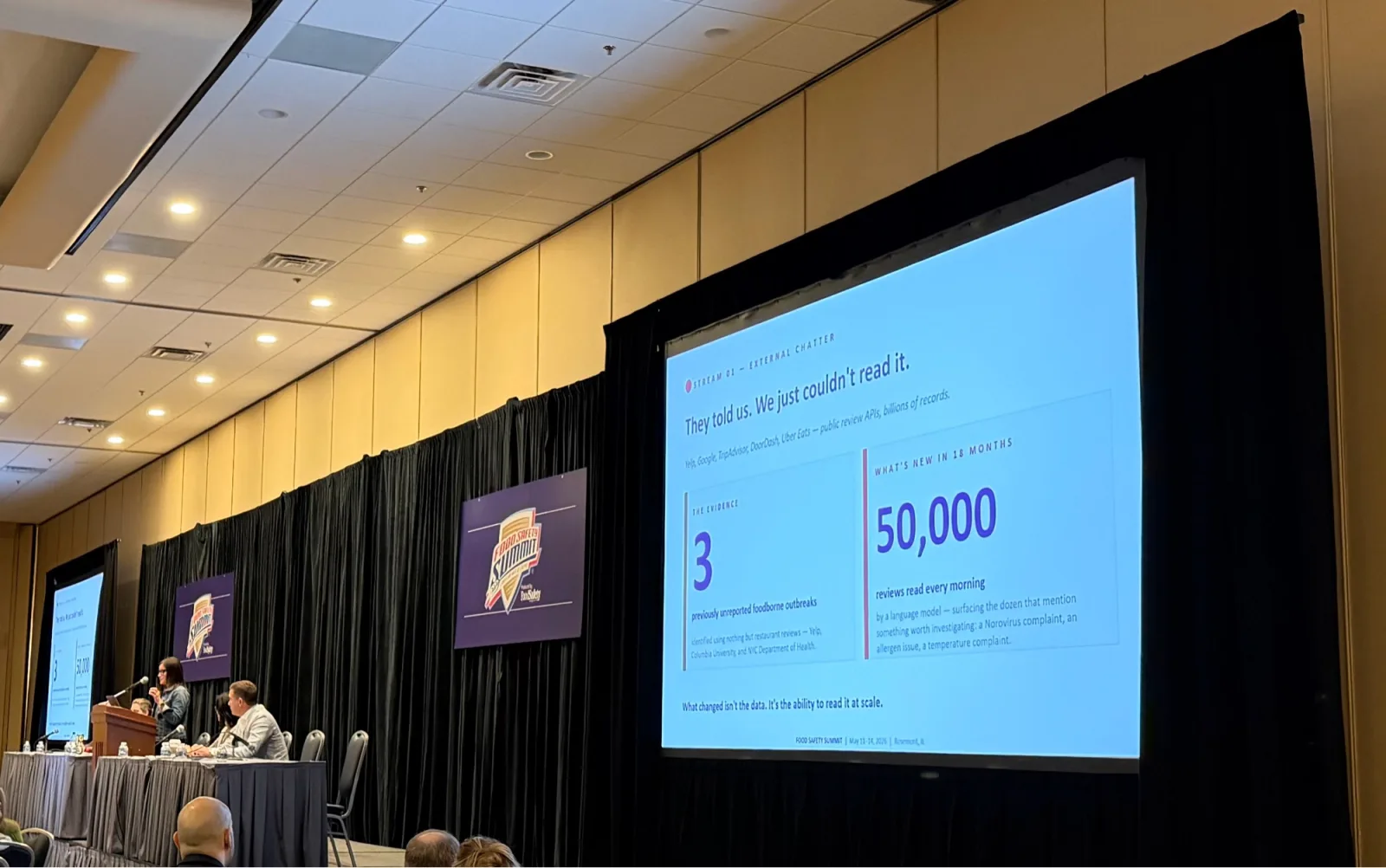 From a slide in the opening AI workshop. The case for AI run against real data at scale.
Lisa Shelley at NC State said the future is company-specific AI, not generic chatbots. I've been saying the same thing for two years. It's the entire reason I built Beacon the way I built it. Generic ChatGPT doesn't know your CCPs, your supplier list, your last three CAPA closures, or the equipment your second shift hates. A company-specific model that does is a different category of tool.
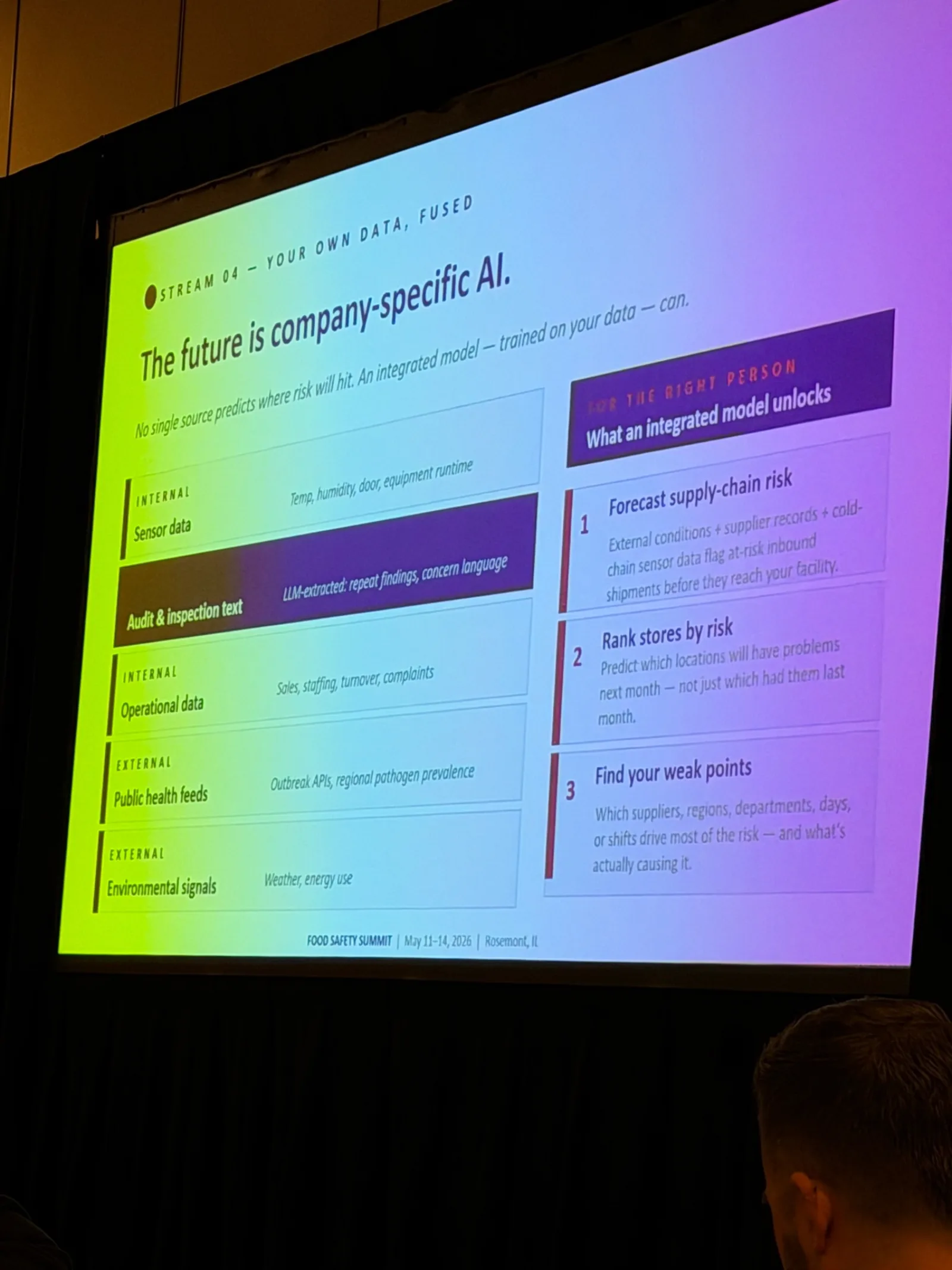 Another speaker in the AI workshop, same thesis. The company-specific AI argument came from more than just Shelley.
The gap: nobody in the room had a clean way to get there. The big companies were funding internal builds. Everybody else was prompting ChatGPT on a phone.
The harborage walk got uncomfortable fast
Sharon Birkett ran the pathogen-control workshop. The format was good: walk a notional plant, identify every spot a pathogen could hide, talk through mitigation.
I hadn't thought to look in half these places. Cable tray crevices. Drain housings. Gasket seams on equipment that hasn't been opened in five years. The underside of a conveyor support arm where condensation collects. Under every example was the same problem. A lot of harborage sites live on equipment that's older than the people running it.
That part didn't get answered.
Attendees raised the 20- to 30-year-old equipment problem. A speaker referenced an equipment-replacement budget. That works for the speaker's company. The 25-person family-owned operation in Michigan, Wisconsin, Iowa, or Texas can't run that play. If the slicer is running, the slicer stays. Nobody had an answer for the SMB version. Managing pathogen risk on equipment that predates your employment and has no service history.
This is a data problem before it's a capex problem. If you can't replace the equipment, you have to track every sanitation event against every harborage site you've identified. And you have to do it in a way the next QA Manager can pick up. Paper logs don't survive that. Spreadsheets don't survive an auditor asking "show me every clean of point 14 in the last 18 months" on the spot.
"Food safety economics" was a great session for big companies
The food safety economics workshop covered how to communicate cost-benefit of food safety to leadership. Good premise.
The math was solid. ROI calculators showing prevention of a recall saves seven or eight figures. Cost-of-prevention curves. Frameworks for justifying a sanitation overhaul to a CFO.
None of it fit a manufacturer doing $5M to $20M in revenue.
For a small operator, the financial math isn't "prevent a $10M recall." The financial math is "one bad event closes the business." There's no insurance product that makes a 30-person plant whole after a regulatory shutdown that lasts six months. The decision isn't an ROI calculator. The decision is whether you survive.
I'd like to see a session next year aimed at that math. What the prevention investment looks like when the alternative is bankruptcy. What a 1.5-person QA team buys with $50K. The rank-order of investments for a plant with no margin for error.
Nestlé's digital HACCP rollout was the cleanest case study of the week
David Clifford walked through Nestlé's global HACCP digitization. Pilot, lessons, global rollout, master data, training.
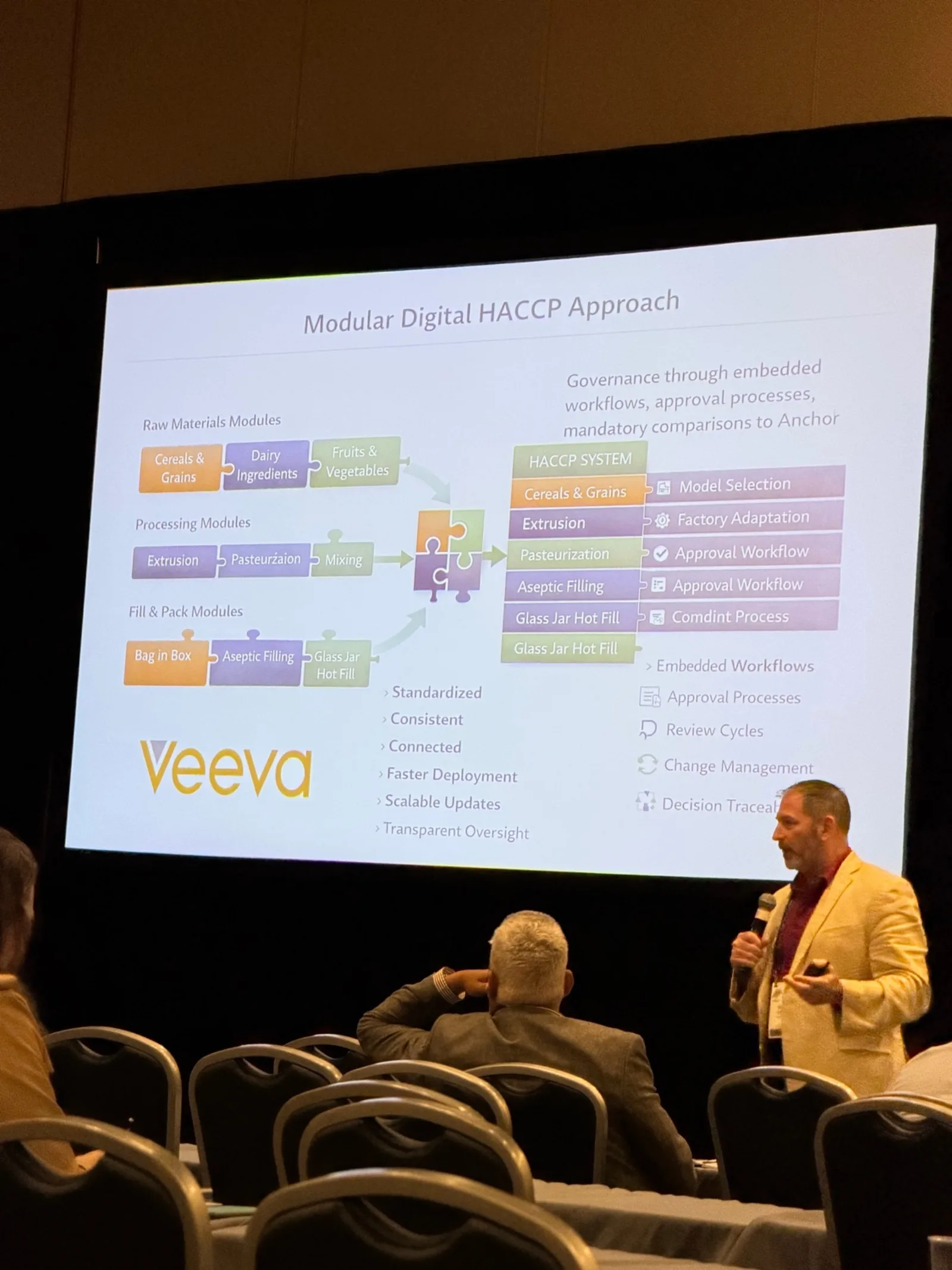 Clifford presenting Nestlé's modular digital HACCP approach.
Two things I took from it that apply at any scale.
One: clean, centralized master data is the prerequisite. If your equipment list, your CCP definitions, and your supplier records don't match across plants, digitizing your HACCP doesn't give you a global HACCP. It gives you a digital version of the chaos.
Two: digitization fails when you don't bring the floor along. The thread through every digital migration I've watched (and a few I've run) is the same. If the line lead doesn't trust the new system, they'll keep the paper backup, and you'll get exactly zero of the value you paid for.
One line from the talk stuck with me afterward.
Clifford mentioned, almost in passing, that two years into Nestlé's rollout with a large enterprise vendor, he still doesn't have role-based access permissions he can configure himself. He sounded frustrated. I would be too.
Read that twice. Nestlé. Two years. I'd guess millions in. Still no RBAC.
That's not a Nestlé problem. That's an enterprise food safety vendor problem. RBAC is week-one functionality. If you can't configure permissions yourself two years into a multi-million-dollar contract, the vendor's priorities are not yours.
The cost-center-to-value-creator session needed an SMB seat
A session on translating food safety into financial relevance for executives. Good content. Real point.
The implicit audience was the QA Director at a $500M company who reports to a VP of Operations and has to make a case to a CFO. The SMB version of this conversation is different. At a 30-person plant, the QA lead, the owner, and the CFO are usually three people who can be in the same room in five minutes. The silo to break isn't finance vs. quality. It's "QA is the person who writes the SOPs" vs. "QA is the person who tells me when a decision is going to cost us our customer."
The bridge the session described is real. The bridge for a small plant is shorter and louder.
The Town Hall heard the room
The 15th annual Town Hall sat senior regulators from AFDO, CDC, FDA, and USDA on one stage.
The audience pushed hard on one point. The regulatory agencies are too siloed and the system is too complicated to work through. A manufacturer in our space ends up dealing with FDA for one product line, USDA for another, state ag for another, and the rules read differently depending on which inspector walked in that morning. Several attendees floated the idea of a cross-agency team for food safety.
I don't know if a single agency is politically possible. I know the request from the room wasn't framed as an aspiration. It was framed as exhaustion. The people in the room run plants. They're spending real money translating between three regulators who don't coordinate. That's not a technology gap. It's the kind of problem a shared platform across agencies could absorb in a hurry. I doubt that gets built. I'd like to be wrong.
The Tech Tent talk that surprised me
Dr. Alex Athey at Zeroic presented ozone nanobubble technology. Eight years of validation, independent lab trials, plant trials on produce and proteins. The pitch is that ozone delivered via nanobubbles works as an antimicrobial without the chemical residue or the costs that killed previous ozone attempts.
I don't have the chemistry background to evaluate the science. The pitch and the data looked compelling. If you run a produce wash line, this is worth twenty minutes.
Food safety culture was the thread under every session
Every session ended back there. The AI panel did. The harborage walk did. The Town Hall did.
The version of food safety culture I heard on stage is the one I believe. It isn't a poster on a wall. It's the line operator on third shift who stops the line because something doesn't look right, and the owner who backs that decision the next morning. It's QA having authority that doesn't require a manager to sign off. It's leadership understanding what a CAPA actually costs to close, not just what it costs to open.
The SQF Edition 10 auditor interpretation came up several times. Auditors are walking the floor and asking line workers what they do and why. They aren't asking to see the checklist. They're asking the operator to explain the food safety reason behind the step they're doing. If the operator can't, the culture isn't real, no matter what the score is. We wrote more about what auditors actually look for behind a food safety culture score if that part of Edition 10 is on your list this year.
That's the right test. It's also the test paper-based and checklist-based compliance systems can't help you pass. You either build the culture or you don't.
What I took home
The summit was well-run. Good size, well-programmed, the right people in the rooms. I learned things I'll use.
What I kept noticing was who wasn't in the conversation. Every case study, every framework, every "here is how we built it" came from a company with the headcount and capex budget to build it. The small to mid-size manufacturer, which is most of the industry by plant count, was in the audience, not on the stage.
That gap is why I built Beacon. I needed a compliance platform that fit a small SQF-certified plant in Michigan, not a Cargill global rollout. Everything on the market either cost six figures and took six months to implement, or cost less and only did 80% of the job. I built the version for the scale this industry actually runs at.
If you run an SMB plant and want to talk through how Beacon could fit, book a call. Happy to walk you through it.
From the Brief archive
All The Brief
By the Time FDA Names the Food, Your Lot Is Gone
Steven Moussawer · Sep 22, 2026 · 6 min read
FDA Would Require GRAS Notices. Ask Suppliers Who Decided.
Steven Moussawer · Sep 15, 2026 · 8 min read
The SQF Agents & Brokers Code, Explained for Buyers
Steven Moussawer · Jul 22, 2026 · 7 min read
Run a food safety program? See how Beacon keeps it audit-ready.
See Beacon in 20 minutes