


Close the loop, every finding to evidence.
Corrective and preventive actions (CAPAs), customer complaints, non-conformances, specifications carrying each product's quality parameters and their limits, and training records on one platform, with clear ownership, escalation, and an audit trail on every record. A CAPA does not close until the fix is verified.
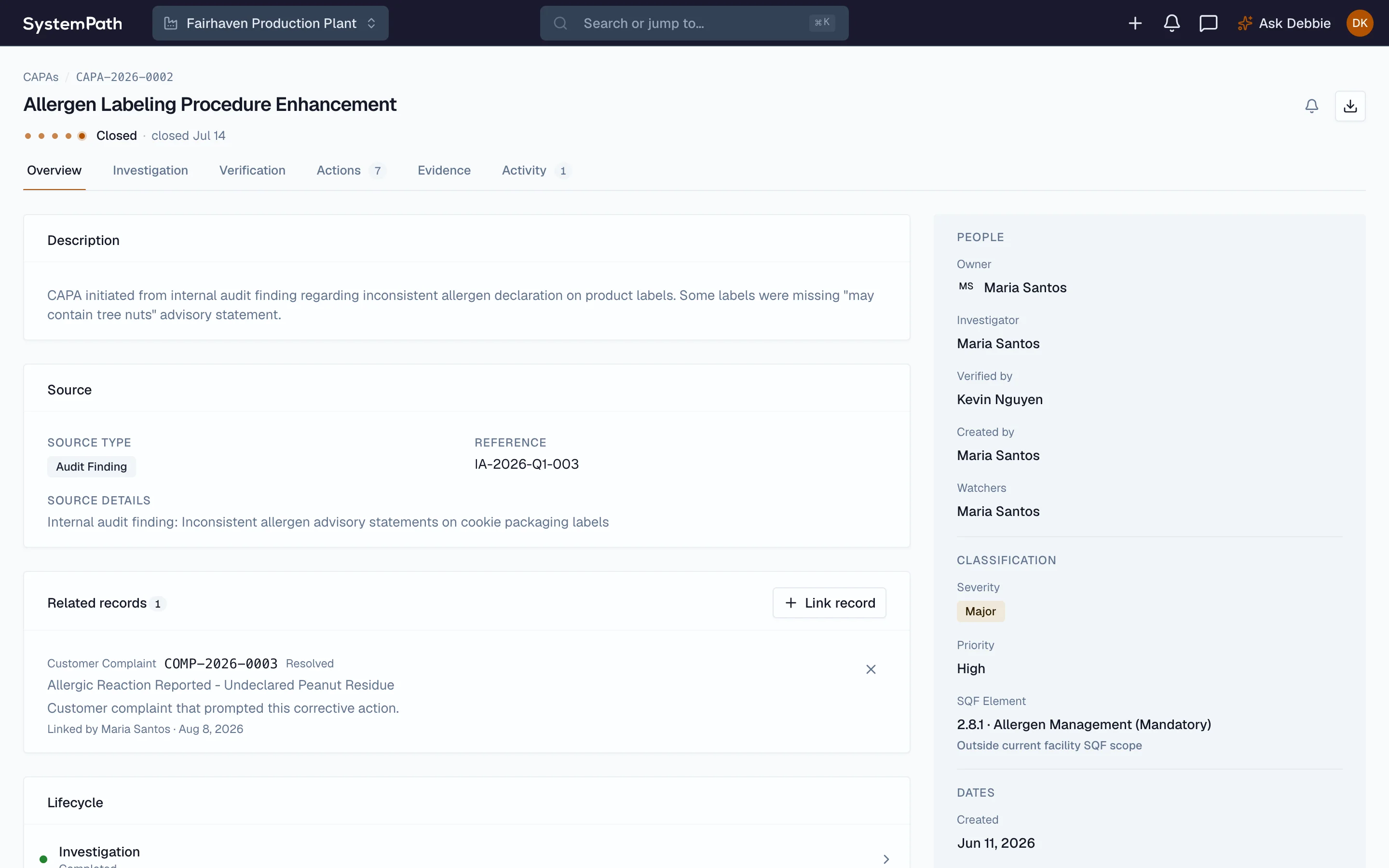
Root cause to verified effectiveness, on one record.
Every corrective action carries its source, its owner, and its full history. Structured root cause analysis is recorded on the CAPA, and the AI can draft a root cause and a plan from the finding for your team to refine, leaving an evidence record of what it proposed. Then the part a task tool cannot do: the effectiveness criteria are written down before the fix is made, and the CAPA stays open until someone records the outcome against them. Closing is a decision with evidence behind it, not a checkbox.
- The full lifecycle, not just a task to mark done
- Structured root cause analysis on the record
- An AI-drafted root cause for your team to approve
- Effectiveness criteria set up front, outcome recorded against them
- Verified by someone other than the investigator
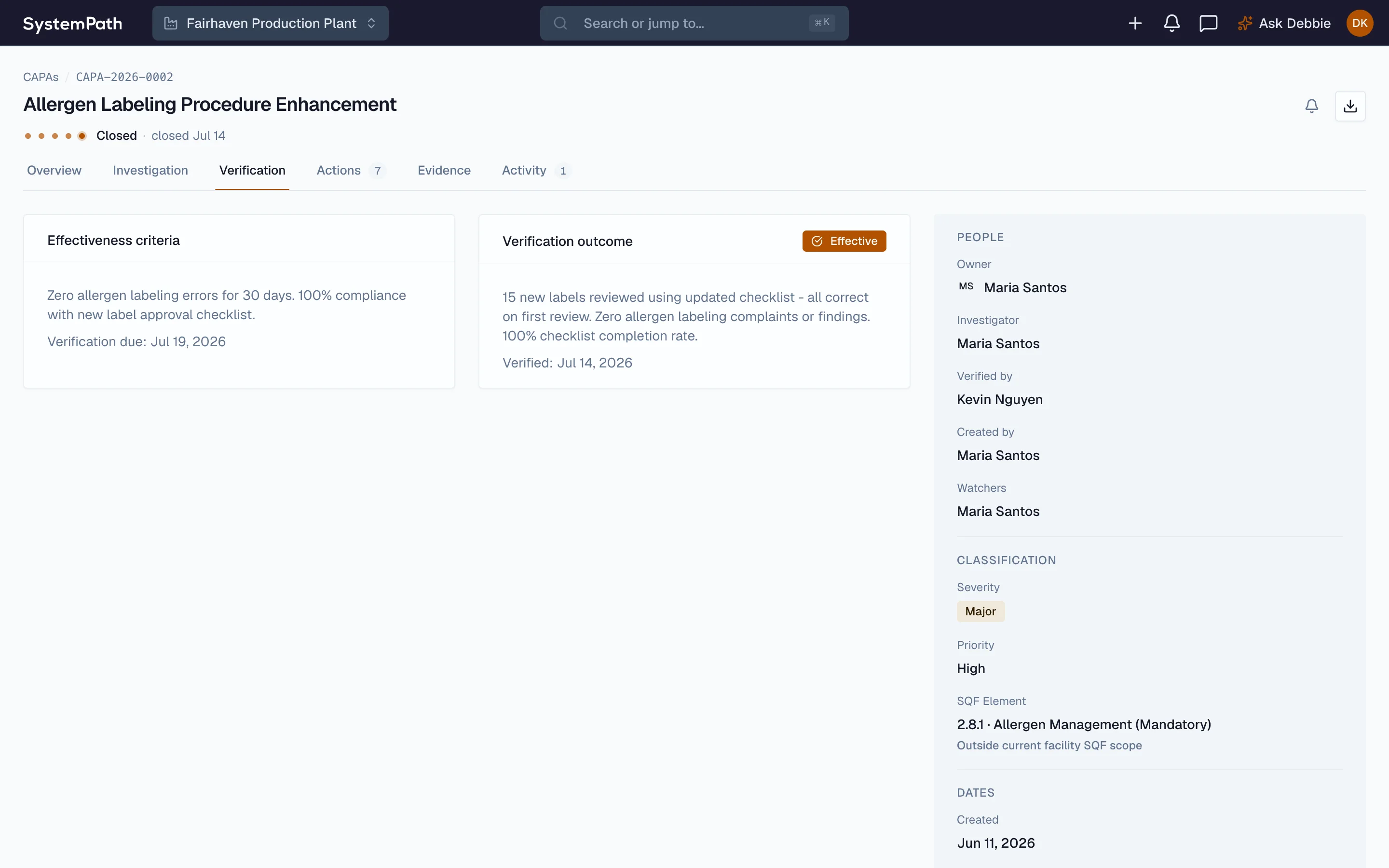
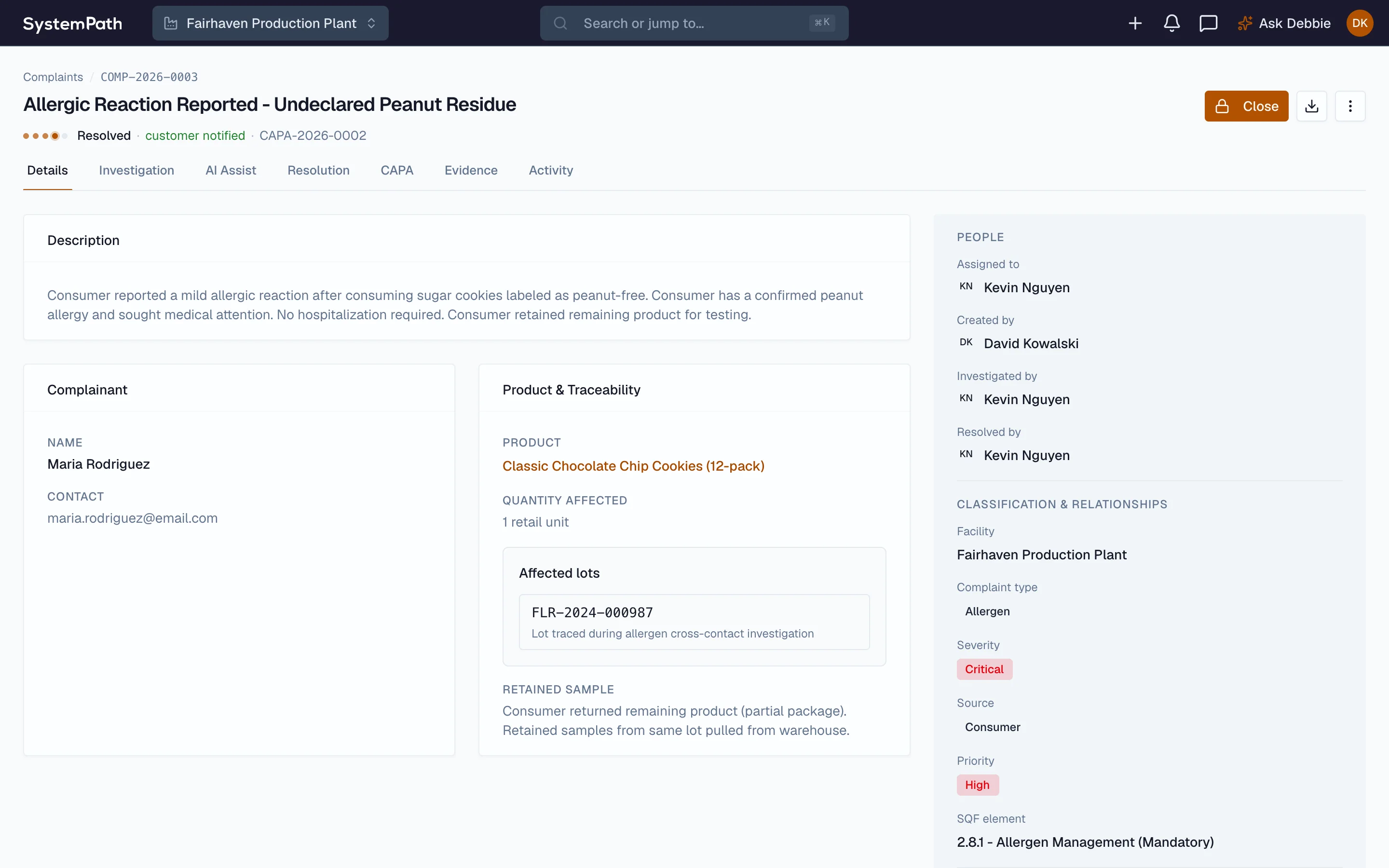
Every issue arrives somewhere it cannot be lost.
A customer complaint ties to the lot it concerns, so the investigation has the genealogy, the production record, and the retained sample in reach, and it drafts a corrective action for review when it warrants one. A non-conformance holds its material until a Material Review Board disposition is submitted and approved. The same is true in the other direction: a finished lot does not release until its quality evidence is green.
- Complaints tied to the lot, with a path to a corrective action
- Retained samples and customer notification on the record
- Non-conformances held for a material review board disposition
- A CAPA drafted or linked at the point the disposition is approved
- A gated lot release, checked per lot before it ships
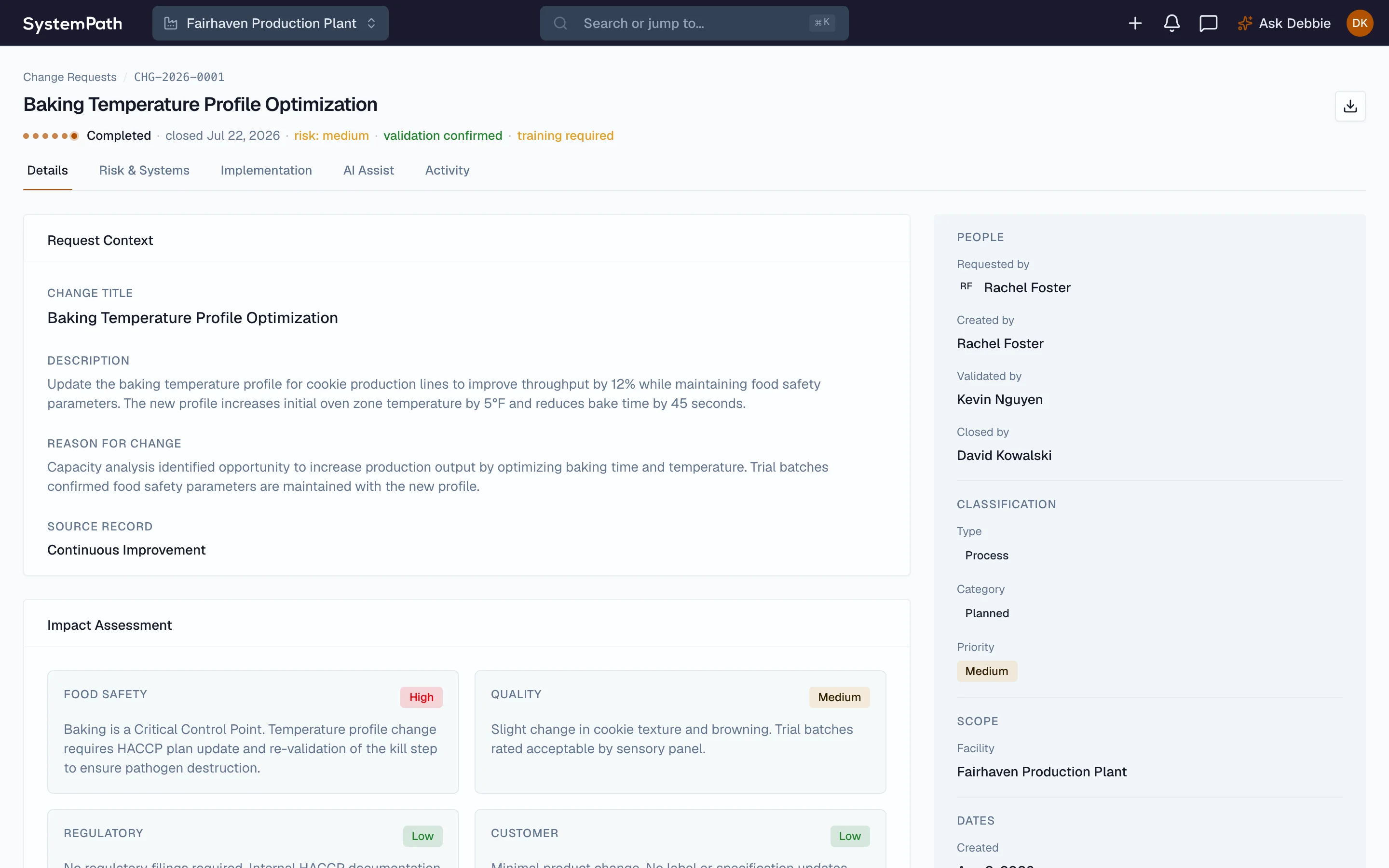
A change that touches a CCP does not go live on a hunch.
A change request records why the change is wanted and scores its impact across food safety, quality, regulatory, and customer, each with the reasoning written out. Where the impact is on a critical control point, the plan update and re-validation are part of the request rather than something to remember afterwards. Validation is confirmed by a different person than the one who asked for it, and the training the change requires is flagged on the record.
- Impact scored across food safety, quality, regulatory, and customer
- Requested, validated, and closed by different people
- Validation and re-validation tasks on the request itself
- Training flagged where the change needs it
- Overdue actions escalate on policy rather than ageing quietly
Every quality question an auditor asks, answered before they walk in.
The quality system is the part of an audit that gets tested hardest, because it is where a plant either proves it fixes things or proves it files them. These are cross-record questions, and they are only quick if the finding, the fix, and the proof share a record.
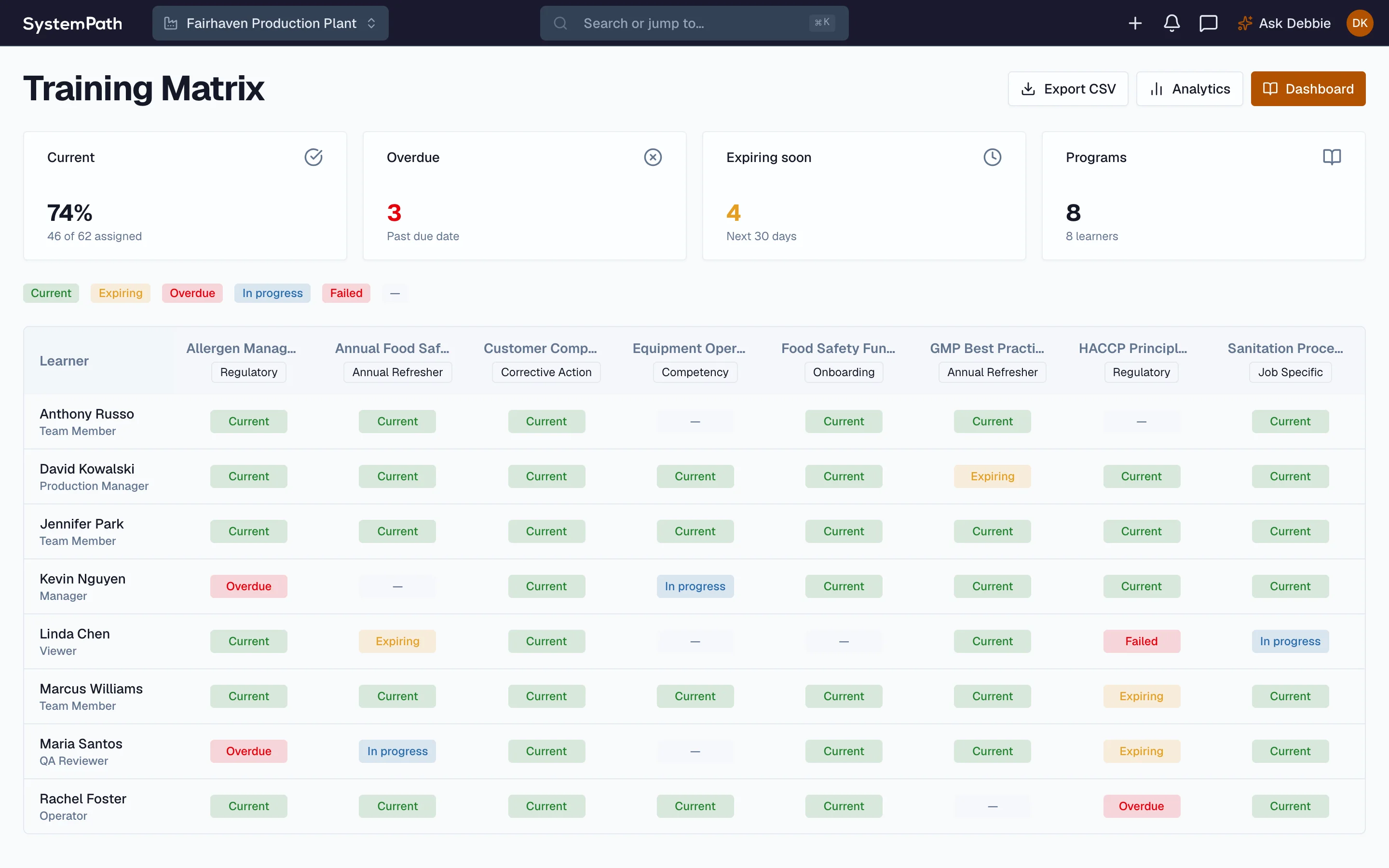
Learners down one axis, programs across the other, and a status in every cell: current, expiring, overdue, in progress, or failed. The matrix an auditor asks for is the live one, not a spreadsheet somebody rebuilds the week before.
Explore Training matrix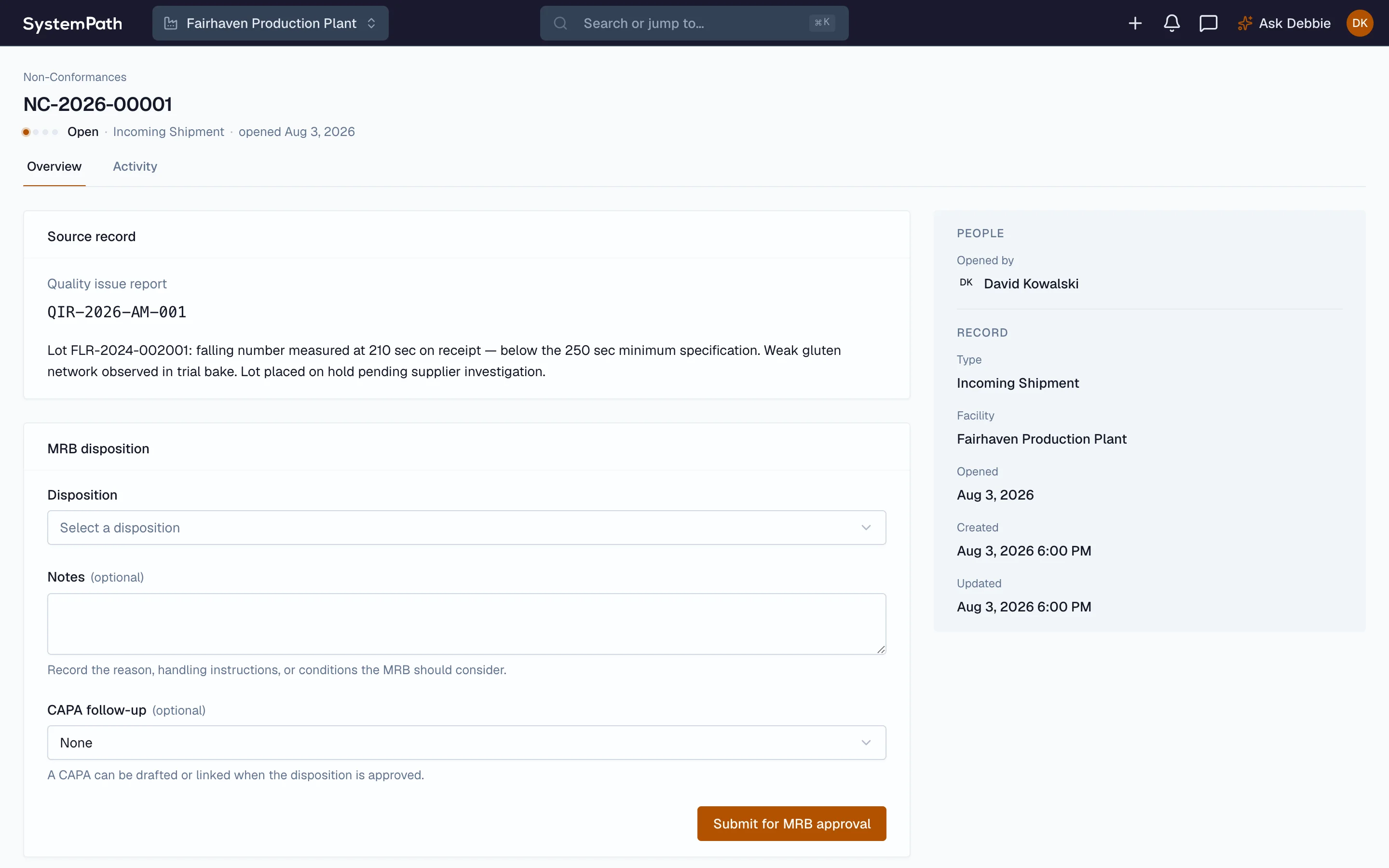
The non-conformance carries the quality issue report it came from and stays open until a Material Review Board disposition is submitted and approved. A CAPA can be drafted or linked at the point the disposition is approved, so the follow-up is part of the decision rather than a separate promise.
Explore Non-conformance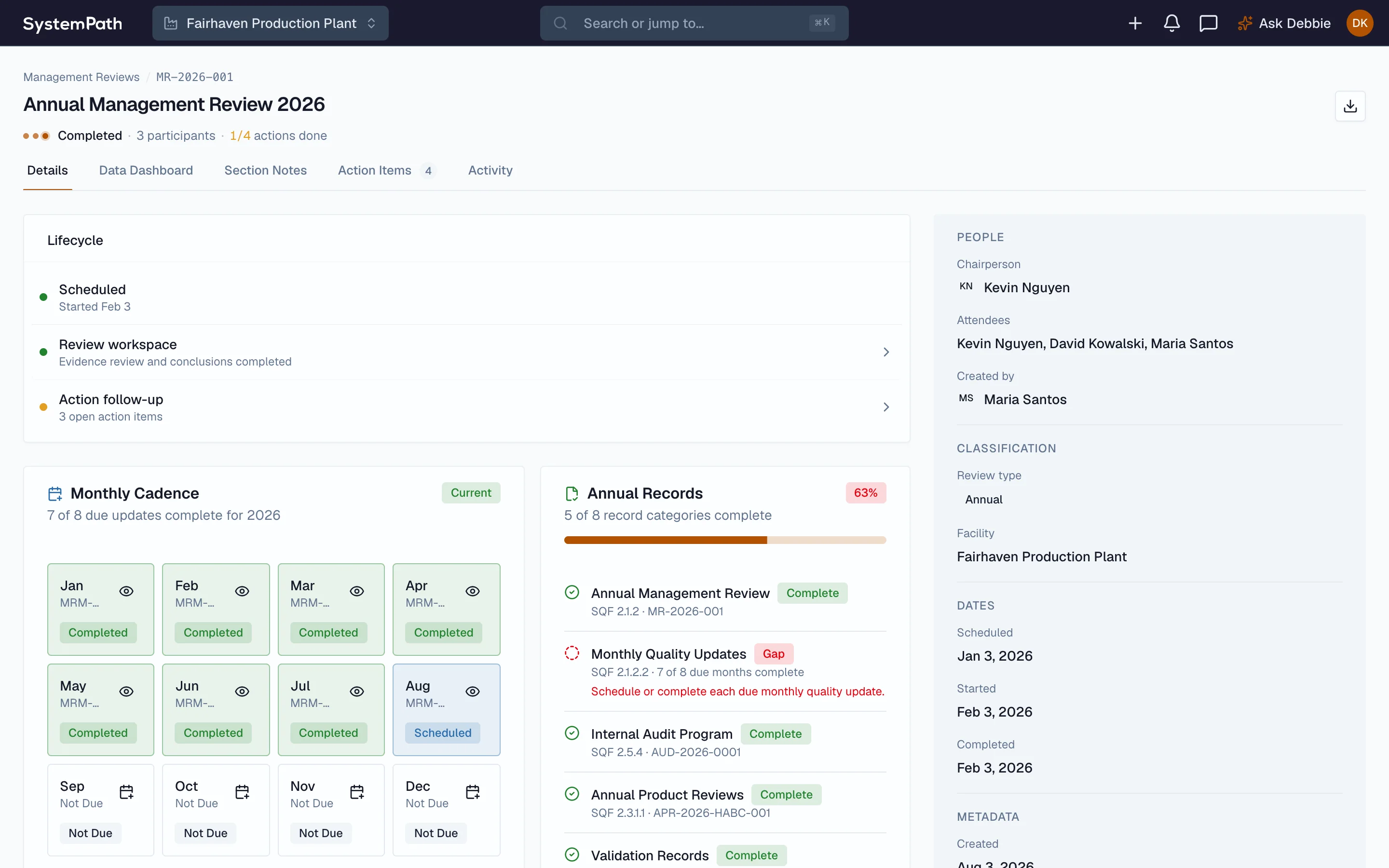
The review is a record with its inputs attached: the annual record categories it needs, the monthly cadence it is measured against, its attendees, and its action items tracked to closure. Where an input is missing it says so, and names the clause, before a registrar does.
Explore Management review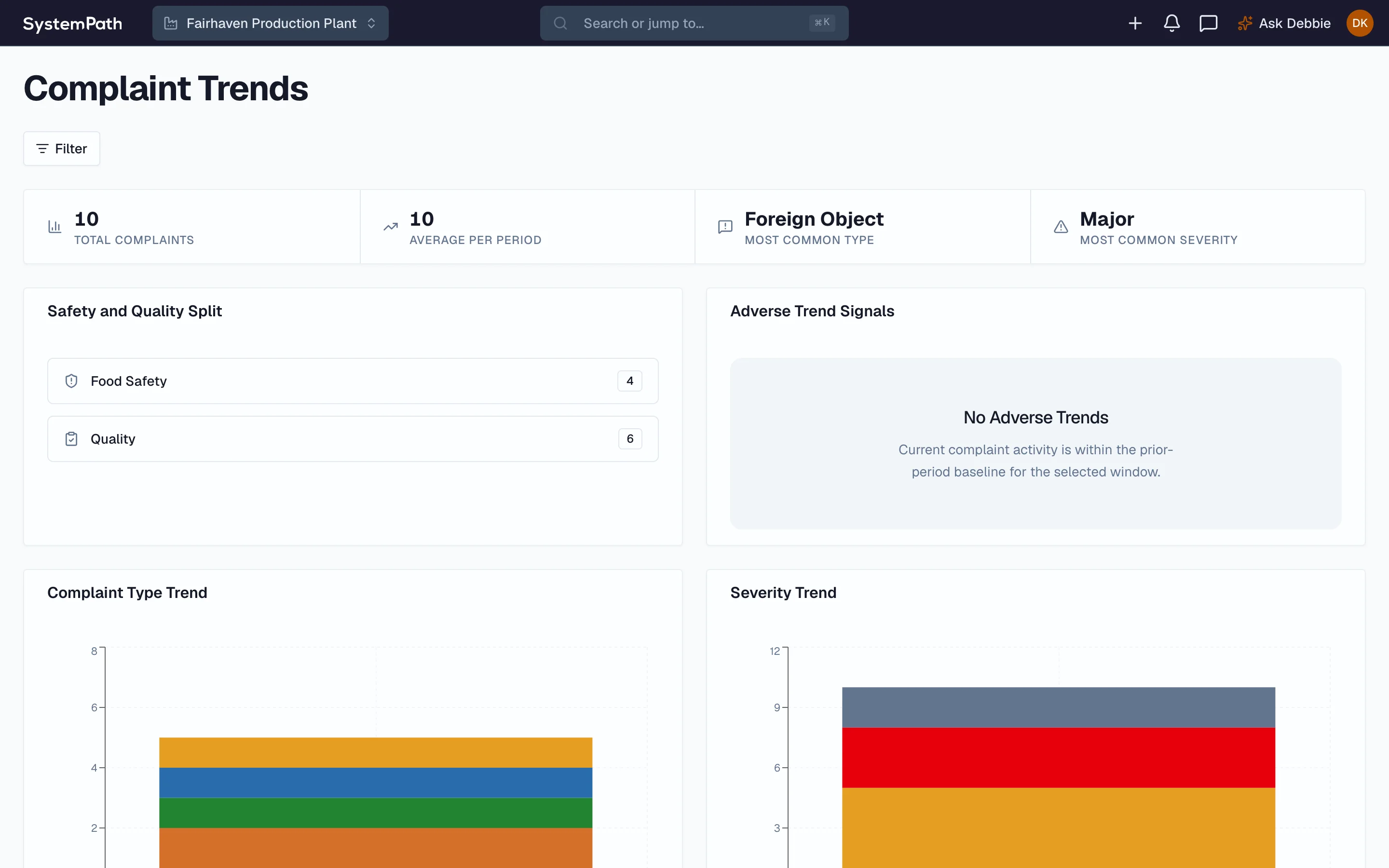
Complaints chart by type and severity and are measured against the prior-period baseline, so an adverse trend is called out rather than left for you to notice. The recurring cause behind three separate complaints stops hiding in three closed records.
Explore Complaint trendsSee a CAPA close on proof, not a checkbox.
A 20-minute walkthrough of corrective actions, complaints, and training records on real data. Bring the corrective action you are least confident about.
Prefer the phone? (313) 484-4887
What happens next
Discovery call
About your open actions, your complaint volume, and your training matrix.
Live walkthrough
A corrective action blocked from closing until verification is recorded.
Custom proposal
Software, consulting, and training sized to your operation.
You'll talk with a food safety expert, not a sales rep.
20 minutes · No commitment · No pressure
Questions quality teams ask.
Answers from the team that runs Beacon inside a working SQF-certified plant.
A corrective action moves through defined stages, root cause, action plan, implementation, and verification of effectiveness, and it cannot close until each one is done. A task tool lets you mark something complete; Beacon requires the evidence that the fix worked before the record closes. Every CAPA carries its source, its owner, and its full history.
Beacon supports structured root cause analysis, including the five whys and fishbone-style cause categories, with the analysis recorded on the CAPA. The AI can draft a root cause and a corrective plan from the finding for your team to refine and approve, so you start from a structured draft rather than a blank box, and the draft leaves an evidence record.
A customer complaint can be tied to the lot it concerns, so the investigation has the genealogy, the production record, and the monitoring data for that lot in reach. If the complaint warrants it, Beacon drafts a corrective action from the same record for your team to review, with the complaint as its source.
Specifications are versioned, controlled records that carry the product's quality parameters, each attribute with its limits, and an approved version is immutable: a revision starts as a new draft and takes over only after approval. Lot release checks the evidence against the current specification, so a lot that fails a parameter is held, and a deliberate exception is recorded as a concession rather than a quiet override.
Training requirements map to roles, so the system knows which courses and qualifications each role needs, and work surfaces that require a qualification check it before the work is recorded. Records carry completion dates and expirations, and a reminder fires before a qualification lapses, so the training matrix an auditor asks for is always current.
A finding from an internal or external audit can open a corrective action directly, with the finding as its source, so nothing is left on a list to be transcribed later. The same is true for a deviation, a complaint, or a non-conformance, which is what keeps every issue in one place where you can see whether it was actually resolved.
Complaint trends are charted by type, severity, and product, and measured against the prior-period baseline so an adverse trend is called out rather than left for you to spot. Corrective actions carry aging and status rollups. Because complaints, non-conformances, and corrective actions link to their sources on one platform, the pattern behind a repeat issue is visible rather than spread across binders.
Yes. A management review runs as its own record: inputs pulled from the live system as evidence snapshots, decisions and action items tracked to closure, and a PDF output for the registrar. The review that used to mean a scramble through six binders becomes an agenda with its data already attached, and the gaps in that data named before the registrar names them.