


Field Notes · May 18, 2026 · Updated Aug 16, 2026 · 7 min read
Three Dessert Recalls in 30 Days. Three Different Hazards.
Three premium consumer dessert SKUs got recalled in 30 days for foreign objects. Lactalis Specially SELECTED Vanilla Creme Brulee for glass. My Mochi Strawberry Non-Dairy Frozen Dessert for an unidentified foreign object. Straus Family Creamery organic ice cream for metal across six SKUs in 17 states. Three different mechanisms at three different points on the line. The question is not whether they are connected. It is whether your physical-hazard control program would catch any of them.
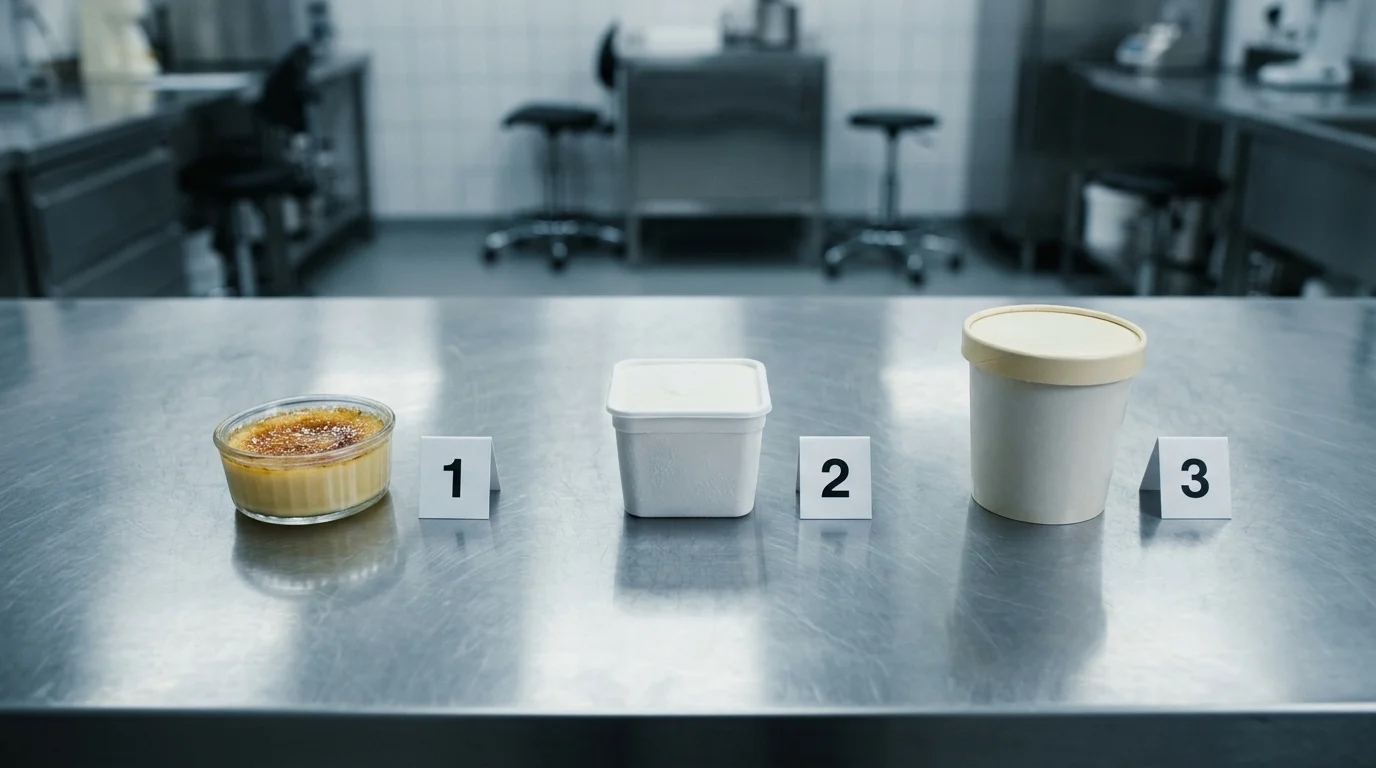
Between April 14 and May 16, FDA logged recalls on three premium consumer dessert SKUs for foreign-object contamination. A glass risk in a chilled creme brulee. An unidentified foreign object in a frozen mochi dessert. Metal across six pint and quart SKUs of organic ice cream, distributed in 17 states.
Three different mechanisms. Three different points on the line.
If you read this as a string of unrelated incidents, you go back to your daily work. If you read it as a prompt to audit your own physical-hazard control program, you find the gap before the recall traces back to you.
That distinction is the whole article.
Lactalis Canada: glass in creme brulee
Class II recall, initiated April 14, 2026.
The product: Specially SELECTED brand Vanilla Creme Brulee, 3.6 oz cups. Specially Selected is Aldi's US private-label premium line. Lactalis Canada is the firm of record on the recall.
Reason FDA published: "Product may contain foreign objects, specifically glass."
Distribution: NY, IN, FL, IL, VA, MD, and MI. Seven states.
What FDA did not publish: where the glass came from. That gap is important. Glass contamination in a chilled dessert plant typically comes from one of three sources. A cracked vessel during cream or sugar handling. A finished-glass container that fractured on the line. A maintenance work order that left glass debris in a zone the cleaning crew did not catch. Each of those root causes lives in a different SOP, so the corrective action is different.
If a plant cannot reconstruct which of the three it was within 24 hours, the recall scope expands because they cannot bracket the affected production cleanly.
For any plant running multiple private-label customers on shared equipment, the additional pressure is that every customer who shares that line is now asking the same question. The glass policy and the changeover protocol need to be documented in a way that holds up to seven different customer audits in the same week.
The Mochi Ice Cream Company: foreign object in frozen dessert
Class II recall, initiated April 20, 2026.
The product: My Mochi Strawberry flavored Non-Dairy Frozen Dessert, 7.5 oz containers, six pieces per package. UPC 0-70934-99645-8. Distributed to six retail consignees with locations nationwide.
Reason FDA published: "Foreign object found inside retail container."
That is the entire description. No identification of what the object was. No identification of where it entered the product.
When the regulatory record is that thin, two things are usually true. The operator did not characterize the contamination before initiating the recall, which means the corrective action is generic and the same gap stays open. And the contaminant was not caught by a routine on-line control, because a metal-detector hit or an X-ray reject produces a known reject record with an investigation tag, not a thin one-line entry. When the public record reads this way, detection was usually after the fact and often through a consumer complaint, not at the line.
The audit question for your own facility is straightforward. When your line generates a foreign-object reject, the rejection-disposition record should identify what the object was, where it likely entered the stream, and whether the upstream control needs adjustment. If the record just says "foreign object," the line is pushing units aside without capturing what would let you stop it from happening again.
Straus Family Creamery: metal in organic ice cream
Recall announced May 16, 2026. Distribution began May 4.
The product: Straus Family Creamery Organic Super Premium Ice Cream across five flavors and six SKUs. Vanilla Bean pint. Strawberry in pint and quart. Cookie Dough pint. Dutch Chocolate quart. Mint Chip pint. Best-by dates December 23 to 30, 2026.
Distribution: 17 states. Arizona, California, Colorado, Connecticut, Florida, Georgia, Iowa, Illinois, Indiana, Maryland, New Jersey, Oregon, Pennsylvania, South Carolina, Texas, Washington, Wisconsin.
Reason in the recall notice: metal pieces. Source not disclosed.
The product mix tells you something. Three of the recalled flavors run through downstream inclusion injection (Cookie Dough chunks, Mint Chip chocolate chips, Strawberry fruit pieces). Vanilla Bean carries particulates blended into the base mix, not injected downstream. Dutch Chocolate is a base ice cream with no particulates at all. Both of the no-inclusion-injection flavors are on the recall anyway, which means the metal entered the product before the inclusion stage. The source is upstream of the inclusion feeder. That points to the mix tank, the homogenizer, the pump train, or the scrape blades inside the continuous freezer barrel.
Six SKUs on the same recall also says the contamination was not a single spike. Whatever shed metal was shedding across the duration of a base-run cycle, long enough to land in multiple consecutive flavor productions.
Three different controls, not one
If you treat all three of these as "foreign-material problems," you go to the metal detector and the X-ray as your answer. That misses two of the three.
A metal detector does not catch glass. Glass control is a separate program. A glass-and-brittle-plastic register that lists every glass surface in the facility. A routine inspection log for each surface. A no-glass-above-the-line rule for exposed product zones. A maintenance-work-order procedure that requires a glass check before the line restarts.
A metal detector does not catch a foreign object that is not metal. Plastic, bone, wood, and stone pass through every metal detector regardless of sensitivity. The control there is upstream. A sieve, a filter, a magnet on a powder line, a sift screen on a dry-ingredient hopper, sized to the smallest contaminant you can reasonably expect to enter that stream.
A metal detector does catch metal, but only if the detector is positioned where the metal actually enters the product and only if the sensitivity is set to catch the size of fragment the most likely source produces. A detector at finished-pack catches large fragments. It does not reliably catch small shavings from a slowly worn scrape blade, because detector sensitivity is calibrated for the finished-pack profile and small particles can fall below the threshold. A blade can shed below-threshold fragments for the length of a base-run cycle before anyone notices.
For each physical-hazard class, the control sits at a different point on the line. The plants in these three recalls had metal detectors. Two of the three failures were not metal-detector misses.
The drill that finds your gaps
Pull your physical-hazard control program. For each hazard class (glass and brittle plastic, metal, wood, hard plastic, foreign matter from raw materials), answer the following.
Is there a written control specific to that hazard, not just a reference to the metal detector?
Is the control positioned at the point on the line where that hazard is most likely to enter?
Is the rejection-disposition record specific enough to identify what was rejected and why?
When a hazard is caught, does the investigation route to the upstream source, or does it stop at "reject and continue"?
For glass specifically, is there a current glass-and-brittle-plastic register, and was it inspected this month?
If you cannot answer yes for all five on any one hazard class, that is the gap.
Then run the audit on your last 90 days of rejection records. If every reject says "foreign object" with no further detail, your line is generating data the way the My Mochi recall record reads. That data does not support root-cause analysis when a recall does happen.
What we built into Beacon
When we built Beacon's HACCP module, we made physical hazards a first-class hazard category alongside biological and chemical, each tied to the process step where it can enter the product. Every physical hazard you identify gets a risk score, a CCP if you assign one, a critical limit, and a monitoring record format. When a monitoring record comes in outside the limit, the system auto-creates a deviation that routes through immediate action, evaluation, and CAPA linkage. You cannot close the deviation without filling out what happened.
That does not replace your glass-and-brittle-plastic register or your metal detector log. It does mean the records that live inside the HACCP plan stay connected to the rest of your food safety system instead of sitting in a separate binder. When the supplier recall 24-hour clock starts, the records pull from one place.
Book a call and I'll show you how the workflow runs.
More in Field Notes
All Field Notes
Two Allergen Recalls in One Day. The Allergens Weren't the Problem.
Steven Moussawer · Apr 27, 2026 · 6 min read

Raw Farm's Tests Came Back Clean. The Outbreak Still Traces to Them.
Steven Moussawer · Apr 21, 2026 · 5 min read

When Your Supplier Causes a Recall, You Have 24 Hours
Steven Moussawer · Apr 14, 2026 · 6 min read
Run a food safety program? See how Beacon keeps it audit-ready.
See Beacon in 20 minutes